
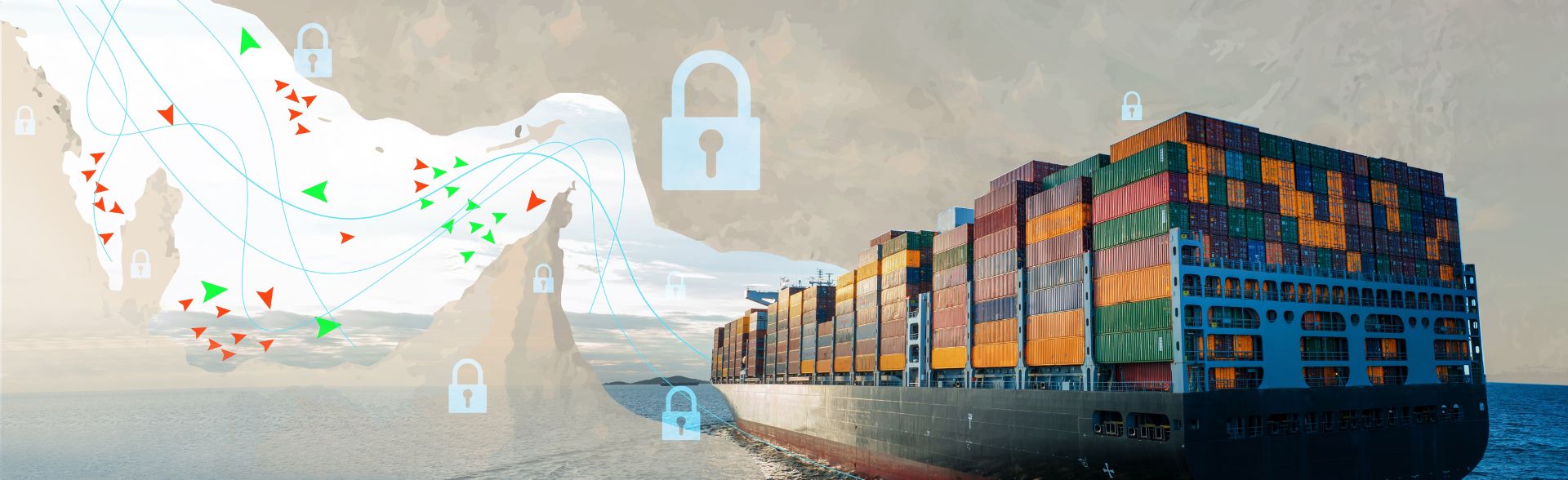
Strait of Hormuz Explained: How the Iran–Israel Conflict Could Disrupt Global Supply Chains
Over the past few days, global attention has been fixed on the rising
tensions between Iran, Israel, and the United States.
News updates mention missile strikes, military responses, and rising
oil prices. For many people, these developments feel like geopolitical news
that belongs to governments and military analysts.
But when conflicts increase in regions like the Middle East, something
else begins to move almost immediately, THE GLOBAL SUPPLY CHAIN.
Ships slow down.
Cargo routes change.
Energy markets react.
And the supply chain teams begin making urgent decisions.
The Strait of Hormuz: A Small Passage With a Massive Impact
Following all these current happenings, a narrow waterway most people
have rarely thought about suddenly becomes one of the most important locations
in the world.
At its narrowest point, the Strait of Hormuz is only about 33
kilometres wide.
On a map, it may look like a small gap between Iran and Oman. But in
reality, it is one of the most critical trade corridors on the planet.
Every day, hundreds of vessels pass through this passage carrying oil,
gas, raw materials, and essential goods to markets across Asia, Europe, and
beyond.
Nearly one-fifth of the world’s oil supply travels through this route,
making it one of the most important energy corridors in global trade.
This is why even a hint of disruption here immediately captures the
attention of governments, shipping companies, and global businesses.
Why the Current Conflict Is Raising Concerns
As tensions rise between Iran, Israel, and the United States, global
shipping companies begin closely monitoring the region.
Even when shipping lanes remain open, uncertainty alone can create disruption.
Vessels may delay entering the Gulf.
Insurance costs for ships can rise sharply.
Logistics companies may begin preparing alternative routes.
These adjustments happen quietly but quickly, because global supply
chains rely heavily on predictable and uninterrupted trade routes.
When uncertainty appears around a critical corridor like the Strait of
Hormuz, the entire system begins preparing for possible delays.
How Supply Chains React in Real Time
One of the defining features of modern supply chains is how quickly
they must respond to global events.
The moment tensions rise near key trade routes, supply chain teams
across the world begin assessing potential risks.
They ask questions such as:
●
Are any of our shipments currently moving through
the Gulf region?
●
Do we depend on suppliers located in affected
areas?
●
Should cargo be rerouted through alternative
routes?
●
Do we have enough inventory if shipments are
delayed?
These decisions often need to be made within hours. Global trade
operates on extremely tight schedules, and even small disruptions can have
cascading effects.
The Ripple Effect on Global Trade
When shipping routes face uncertainty, the impact quickly spreads
beyond the logistics industry.
Energy markets are usually the first to react. If oil shipments face
potential disruptions:
●
Prices may rise as traders anticipate supply
risks.
●
Higher energy prices can then increase
transportation costs across industries.
●
Manufacturers may face delays receiving raw
materials.
●
Retailers may wait longer for imported goods.
●
Businesses may experience rising freight costs.
Eventually, these pressures can influence everyday life in subtle ways
ranging from higher fuel prices to delays in product availability.
Lessons the World Has Already Learned
The past few years have demonstrated how sensitive global supply
chains can be to disruptions.
The pandemic slowed production and overwhelmed ports worldwide.
The blockage of the Suez Canal showed how one vessel could halt global
trade for days.
Recent disruptions in the Red Sea forced ships to take longer routes
around Africa.
Each of these events highlighted the importance of resilience in
global supply networks.
Now, tensions around the Strait of Hormuz are once again reminding
businesses and governments how much the world depends on a few critical trade
corridors.
A Quiet System That Keeps the World Moving
While global headlines focus on political developments and military
strategies, another system continues working quietly in the background.
Supply chain professionals around the world are monitoring shipments, adjusting logistics plans,
and coordinating with partners across continents.
Their work ensures that energy supplies continue flowing, factories
receive materials, and goods reach markets despite uncertainty.
Moments like the current Iran–Israel–US tensions remind us of
something important.
The global economy runs on complex networks of trade and supply chain.
And when the world becomes uncertain, supply chains are often the first systems
that must adapt